
Gear for 21 days of Backpacking in the Sierras/ on the John Muir Trail
The complete list of what I brought on my 21 day backpacking trip in the Sierras (partial JMT + side quests) and thoughts on what worked and what I would change!

This was my longest continuous backpacking trip ever, and also my first trip in the Sierras! I was unsure about what conditions I would encounter. Would it freeze at night, as it can easily do when hiking above 10,00 feet even in the middle of summer? How often would it be rainy or thundery? With a wide range of possibilities, I packed what I usually bring when I expect to encounter variable and stormy weather in my home mountains of Washington state.
First, some context for the list! This will frame what I packed and what I ended up using on the trip. My hike started July 14, 2026.
Weather Conditions I Encountered
The week before I arrived at the starting point of my trip at Tuolumne Meadows, the overnight lows were in the 20s every night. I saw photos from thru hikers of frosted tents and icy ponds. With potential temps that cold, I made sure I included my full cold weather hiking kit.
But, once I got on trail, the coldest it got was 37F at night, and it poured rain for a good part of my first few days. And then a highly unusual heat dome built over California. Every veteran JMT hiker who had been out here before commented on how warm it was; some days while I was out there it reached 85F at the summit of Whitney!! The upside of this odd weather pattern was warmer nights, fewer storms after the first week, and days of clear, hot, bluebird skies with not a cloud in sight. I could spend hours at the highest passes without any thunderstorm concerns. The big downside was the heat, and how much harder this makes hiking. Coming from western WA I am not acclimated to hiking in hot temps, and I know this added an extra layer of challenge.

Goals and Unique Considerations for My Gear
In addition, I always emphasize that my gear choices are driven by three things:
1) being safe
2) having a good time no matter the conditions
3) the gear I need to stay warm while painting and filming my Adventure Art Academy classes
4) as light as I safely can go.
Unlike other hikers who can just head to the tent or continue moving when it gets cold, I often stop on a ridgeline, pass, or other beautiful spot to paint for hours. This means I need layers to stay warm while completely stationary, so I pretty much always have slightly warmer and more layers than my friends.
The art and camera equipment (including phone) also adds 6lbs to my pack, so I will never be fully ultralight. And with my outdoor guiding and first aid training, my mindset is oriented toward safety instead of as light as possible. I am equipped to deal with bad conditions and an emergency, because I believe that is the prudent and safe way to travel in the wilderness, especially alone. I know many hikers who would disdain this perspective in favor of saving ounces of weight, but for me, this is what drives my thinking.
With that said, next time I would definitely try to lighten my pack where I safely can, and I share notes below on what I would drop from the kit next time. My heaviest load was 43 lbs leaving Muir Trail Ranch with 7.5 days of food, which is heavier than I would like.
BACKPACK & ORGANIZATION

Pack- Superior Wilderness Designs (SWD) Big Wild – 70 L, size large (to fit my abnormally long for a woman 21 inch torso). This pack worked great, and continues to be the best backpack I’ve used, especially when I need to carry heavier loads. The large capacity was also very helpful to fit the bear can, which is required in this region.
My pack has the front pouch and to hip belt pockets. I carry my painting tucked behind the front pocket in a Tyvek envelope, and it very secure thanks to the modular design of the Big Wild.
To keep everything organized in the pack and at camp, I used two small stuff sacks (one Dyneema, one fabric) to hold spare clothes plus zippered dyneema pouches for my art kit, filming items, first aid kit, and emergency kit. Normally all of my base layers go in one stuff sack, but with the large bear can that needed to go vertically in the pack, the two smaller sacks worked better as it allowed me to distribute items more evenly. Plus a few other little stuff sacks for other things - since my backpack is basically a single compartment, I prefer to have a baggie for each item category. This makes unpacking and keeping track of everything in the tent and around camp easy! I didn't lose a single item on this trip, and I think this system helped a lot. Everyone will find what works for them! But since I have all the extra tiny items for the art and filming kits, I like to have things highly organized.

Pack Cover- Sea to summit ultrasil. Kept my pack dry in rain and also clean at camp- at night, I put the pack cover on backwards, encasing the harness so it isn’t easily chewable by marmots or other creatures looking for salt. I don’t like having my pack in the tent if I can avoid it due to dust, dirt, and sweaty shoulder straps on long trips.
Fanny Pack - Atom Packs Roo - the larger size fanny pack from them is now my go-to for every hike. It fits plenty without feeling bulky, the zipper is great, and the design is effective in keeping items in the Roo even if I forget to zip it.
TENT & SLEEP SYSTEM

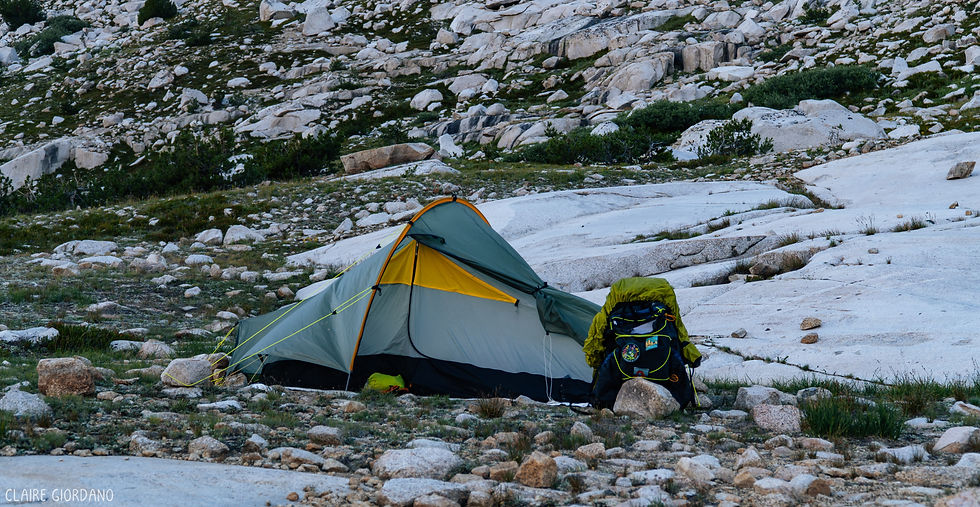
Tent – Tarptent Moment DW – Love this tent so much. Absolutely stellar in wind when the main hoop pole is guyed out and the edges of the fly are also guyed out. Tyvek groundcloth (lightweight kite making variety) which was, to me, necessary because of how rocky most sites were. I could save some weight by only bringing the two long stakes needed to stake out the ends of the tent and ditching the other six groundhog mini stakes, as I was always able to find rocks to use instead. Most nights I set up the whole tent with rocks alone, which is very easy to do with this tent!!
Sleeping bag – Feathered Friends Petrel 10F. Due to the warm temps (coldest it got at night at 37, often in the 40s to even low 50s), I slept half my nights with this bag open like a quilt. On the colder nights I was so glad to have it because I was comfy. I would not trade it out for a lighter bag because I sleep very cold, and it is most often colder at the higher elevations (the majority of my campsites were at 9-10k feet).
Sleeping pad: Thermarest X-therm (regular mummy shape). Warm and space efficient, I also see this as cold weather insurance.
Pillow: Sea to Summit Aeros ultralight pillow with a super lightweight buff on it that weighs almost nothing as a pillow case. The buff is a small luxury, but it keeps my pillow clean, which I personally really value on a long trip.
Sit pad: Thermarest z-lite – I feel like this item should really go in the art kit section, because I bring it to keep me comfy and warm while painting and filming. If I didn’t use it for that, I would bring a smaller piece of foam for breaks and sitting around camp. The larger pad makes my life so much nicer when I’m sitting on the cold ground for a few hours, so I bring it along. It also gets used under the air pad at night- since I have it along, might as well do this.
FOOD & WATER

Filtration – Platypus Quickdraw Filter, plus steripen (physical filters do not remove viruses, and I wanted this extra level of protection from Norovirus provided by the steripen at the popular lakes where I couldn’t get running water)
Bottles – Nalgene (milky white plastic one, which is lighter) and one platypus bottle. Plus
hose and adapter for the Platypus that turns it into a hydration bladder! (adapter from Brian Bean Designs on Etsy, works great!)
Bear Can- Wild Ideas Bearikade Blazer – this thing was awesome. Easily fit my 7+ day carry with the extra liter of space compared to the blue BV500. Plus, 9 oz lighter!! Expensive but so worth it, and I’ve already used it on other trips. Best new gear I bought this year!!!

Cook Kit
BRS 3000 stove
oaks 900 titanium pot
Pot coozie from Granite Gear – I hot soak my meals!
Small fuel can – the 4oz can lasted me way longer than expected, still some in there after 10 days of making hot water for dinner and four cups of hot water for tea or miso soup. I saved a lot of fuel by holding the z-lite up as a wind break.
Sea to summit spoon
Tiny pack towel that goes with the stove/pot (could skip this towel, but I use it to grab the pot which is needed some nights if it gets too hot. Also keeps the fuel can from rattling in the pot)
A little bit of paper towel (1/2 piece) per day to clean pot
CLOTHING

Rain & Wind Gear
Arc’teryx Alpha SL gore-tex raincoat (no longer in production, which is too bad as it is quite lightweight)
AntiGravityGear Ultralight Rain Pants
Patagonia Wind shirt (1/3 snap style) – I love this thing so much, and wore it off and on every day in the wind.
Insulation
Feathered Friends Ellia- love this jacket! But next time I would bring the Feathered Friends Eos because the new fleece is so warm and the Eos is lighter.
Fleece – Farpointe Alpha 190gsm hoodie. This thing is seriously warm and cozy, and when paired with the wind shirt is an amazing layer. Wore this every single day in camp and on cold mornings to start hiking.
Fleece pants – Arc’teryx Rho from 2023. I’m really torn if I would bring these next time or not. If I had temps like I did on this trip, I could have left them behind, but if I had nighttime temps closer to freezing, these are necessary for me to stay warm. So, forecast dependent.
Worn Clothing
Pants- Patagonia Altvia Alpine (2024 model) – I like the loose fit, tighter cuff to keep dirt out, and the integrated belt to adjust on the go.
Sunshirt – Wuru Wool Ultralight hoody – this thing worked amazingly well. Kept the sun off me, minimal stinky funk, and I only rinsed it out once a week.
Undergarments- Ibex wool undies, Branwyn wool Bralette
Socks – Women's Hike Smartwool Socks

Packed Clothing
Baselayer top – Ibex Nuyarn ¼ zip – so light, only used in tent / evening at camp after wiping the day’s sunscreen and sweat off
Baselayer bottom – older Arc’teryx motus bottoms, also only night use
Spare underwear – brought 2, only needed one spare as easy to wash and dry in the sierras
Spare branwyn bra- could have skipped this
Very lightweight shorts- also would skip never used to swim
Spare socks- 2 pair- I would always bring these. With my feet’s delicate skin, I really value having a dedicated tent sock that I put on only at night after washing feet. The I’d clean and alternate the other 2 pairs. Really helps keep skin salt -free and happy, especially since the hiking socks took a long time to dry, often needing to be hung on my pack while on the move to fully dry.
Spare pee cloth (small piece of flannel fabric, that goes in my pocket)
HATS, GLOVES, & SUN

Sun Hat -Tilley cotton hat. Love this! The wide brim was so nice in the super sunny high elevation terrain
Sun Gloves- Glacier Glove Islamorada- fingerless but still quite long on my smaller hands. Third pair I’ve used. This one did have a larger / thicker seam that irritated my hands so I had to cut that part of the seam on day three.
Sunglasses – Smith Cheetah with replacement lenses from Revant with a VLT of around 11%, which is nice and dark for the bright sierras. ****Make sure you have good high quality sunglasses, and wear them, especially if you have pale-colored eyes or are more sensitive to sun exposure. I have to wear them otherwise my eyes get too irritated and dry, and I met a girl from Poland who had poor quality glasses and sunburned her eyes (called snow blindness), which occurred thanks to all the bright reflective light colored rock!
Warmer thin gloves – Seirus- Windproof and water resistant model but not too thick.
Waterproof gloves – goretex overmitts. I am also torn about these for a future trip. I didn’t use them this year because I was able to time my hiking around the bad weather and avoided hiking in the torrential downpours from the thunderstorms. I added extra food so I could get to camp early and hole up in my tent on the days with the worst weather forecasts. Had I needed to hike in the rain, I really like having these.
Warm hat – Turtlefur “the Hat” original thick fleece hat. Love this thing, never using anything else again. Warm, durable, and the brim can be folded down over my eyes at night, necessary when the moon is so bright you can walk around at midnight with no flashlight. I also brought a fleece headband which I think I could skip next time, even though it was really nice to have on cold mornings. An ounce, but I could skip.
FOOTWEAR

Boots- Scarpa Kailash gore-tex. On my third pair of these! BUT I need a size bigger as the sides of my big toes took a beating and were very unhappy. No blisters at all though! Pain from pressure not the boot rubbing.
Water crossing shoes – zpacks deluxe camp shoes – wore around camp a few times, but mostly used only for water crossings. The heel enclosure and toggle to tighten make them very usable for this purpose, and they protected my feet just enough!
Down socks (liners from my Feathered friends down booties) – did not use on this trip as too warm, so would skip next time unless a cold forecast.
ELECTRONICS
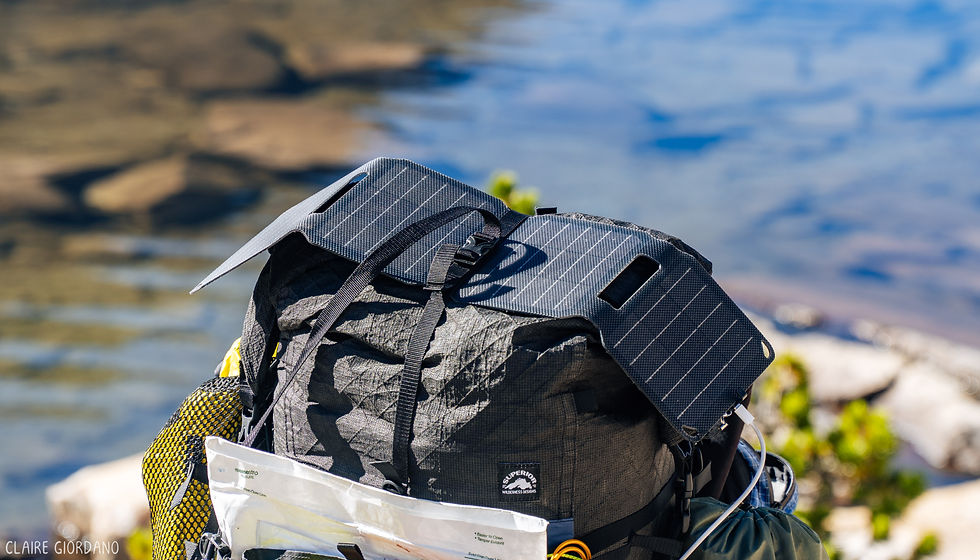
Solar panel & Battery – Flexsolar 10W mini - This thing worked amazing! Provided just the right amount of power for all of my devices, and allowed me to run gaia all day to track my hike, which was so fun. Paired with an apple usb cable and a Nitecore 10k battery bank.
Still images – Sony a6700 with a G 18-105 lens. Heavy, at almost 2lbs, but I honestly can’t imagine not bringing it since photography is part of my job.
Filming for Adventure Art Academy - Gopro 13 with macro lens, mini rode mic with huge wind cover, adapter cables, and a tiny tripod that is the lightest I could find on amazon
A few spare SD cards (brought too many of these!)
Nitecore headlamp
Inreach mini, carried for emergencies / backup if the phone satellite isn’t working
Peak design capture clip and dyneema roll top bag to hold the sony when not carried
Iphone 17 Pro- for navigation with Gaia (paper map as backup, of course), video, and daily satellite coms with the family
OTHER EQUIPMENT
Trekking poles – Leki Makalu from 15 years ago, still going strong, and with titanium very lightweight
Bug protection – sawyer picaridin, one ounce carried and used just a few times early on. But net - never used but I also never leave it behind just in case.
Comprehensive first aid kit, with wound care (steri strips, occlusive bandages), blister care, medications (immodium, ibuprofen, decongestant, Dayquil, flu etc), and also my albuterol inhaler and antibiotics (finally convinced my doc to give me these, as I am prone to cellulitis skin infections). I need to make a blog post about everything in this as there is a lot more. On cold nights this goes inside my sleeping bag, as the antibiotics can’t freeze.
Tiny packtowel washcloth- thin and light, I use this for a lot of stuff, from washing up to removing debris from inside the tent each morning and wiping the worst of the dust off the tent in the really dusty sites
Emergency/ oh sh*t kit – a little dyneema zippered pouch that has a space blanket, fire starter and matches, my multitool, whistle, spare n95 masks for smoke, thread, safety pin, and thermarest patch kit. Extra weight but I like having it.
Toiletries
Half-handled toothbrush, toothpaste, floss
0.5 oz hand sanitizer
Earplugs
A carbon fiber tiny comb
A&D ointment to prevent chaffing if needed, and antibiotic ointment
Retainers, a few tiny hairbands
Toilet paper and dried baby wipes (1.5 per day plus a few extras)
Arnica gel- helps a lot with sore feet or bruises
PAINTING KIT

Here’s the minimum kit I take with me. On this trip, I had a few extra brushes I should have left home, so those are not listed.
Brushes- #10 round and a #6 round, ½ in angle shader flat brush, and a large #4 quill round brush
Art Toolkit Folio palette with 26 colors, Daniel Smith paint
Tyvek sleeve with plastic cardboard piece for stiffness that holds paper and is painting surface
2 blue shop towels (reusable and can clean)
Pencil (usually pentel 07), kneaded eraser and bit of plastic white eraser
Micron 05 pen and Lumos pen (micron to journal, could have left at home)
Mint tin for water

ITEMS I’D SKIP NEXT TIME
There were only a handful of things that I would skip next time, as I am the kind of hiker who prefers to have a margin for safety and emergency, and to be able to paint if I want to in all conditions.
Lightweight running shorts- while only a few ounces, I used them once to swim, and would not bring again, as I really am not a swimmer
Second sports bra- would only bring one, as the wool branwyn did not need to be washed often, and when I had a shorter day here and there I could rinse out and have it dry in camp
Tshirt- I sent home my wool tshirt after the first five days, wasn’t wearing it!!
Lotion – I did not need a whole ounce of hand lotion, I used very little. The bit I did use seemed to really help my hands, however, so I would bring some, just not this much
Extra mechanical pencil and lead- grabbed wrong pencil at home and took the one with very little lead, and bought a two pack on the road. Accidentally brought both along and didn’t have the heart to throw away so I carried them the whole way
Spare SD cards- only needed one spare for the sony’s 256 g card, and didn’t use the spares for the gopro, which had a 256 g card and easily fit 6 classes filmed in 4k
Third underwear- two would have worked just fine
Fleece headband
Paper tiny journals - I ended up just writing or voice-to-texting notes on my phone, as this was much much faster than hand writing.
Food- I ate everything really well except for my drink mixes, so I’d make this smaller and only bring one packet or two for hard days of liquidiv per day, and skip cocoa/ apple cider packets and even though I loved them, I could also skip the Miso packets. Extensive blog post about food coming soon! I also did not need my nighttime almonds snack, as the protein powder did the trick here.
Single use preservative free eye drops (didn’t need) and my night time eye gel, also not needed as long as I wore my sunglasses most of the day to keep my eyes from getting too dried out
My NatGeo JMT map book. I used this very little, since I had the Elizabeth Wenk guidebook on my phone and that includes coordinates and descriptions for all major campsites. Instead, I would bring maps printed from Caltopo that I could ditch and switch out at each resupply. Gaia on my phone was primary navigation tool in combination with guidebook.
Iphone external flash drive- should have been backing up footage from each day but didn’t, so this was a slight wasted weight.
Hope this might help others as you prepare for this amazing hike! Hop in the comments if you have any questions!


Comments